

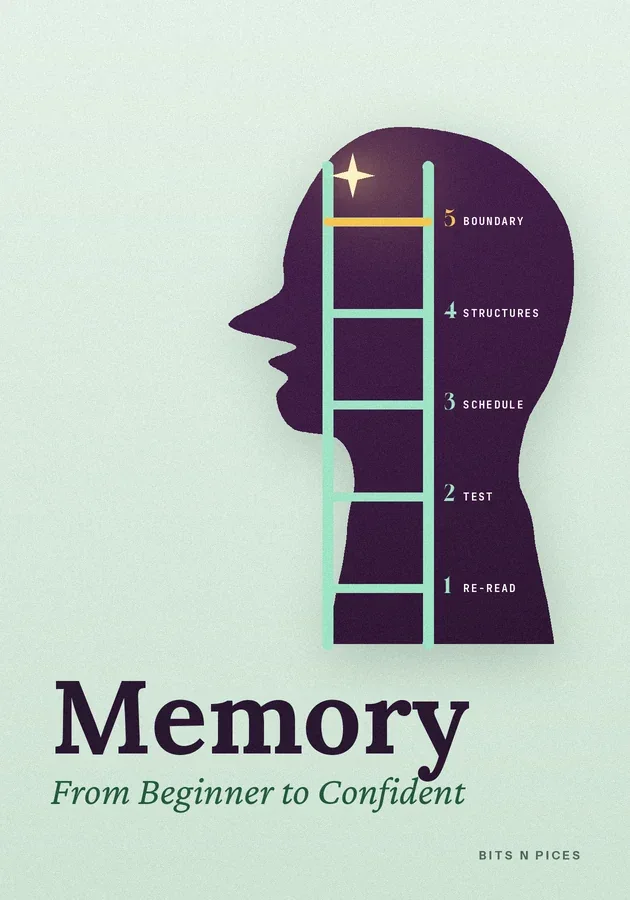
Memory: From Beginner to Confident
Principais ideias
- Run a cold-start test on something you learned a month ago; what survives with no warning shows your real rung better than any study session.
- Predict your score before every self-test and compare afterwards, because honest calibration tells you which knowledge to trust and where to spend your time.
- Cap how many new items you add each day, since every addition books months of reviews and unmanaged review debt quietly kills good habits.
- Organise facts around a few principles and save mnemonics for arbitrary material, because frameworks scale where hundreds of vivid images start to blur.
- Decide deliberately what belongs in your head, the knowledge you need fast or think with, and keep everything else in a reliable, well-sourced reference.
Dentro deste bit
- Five rungs from hoping to designing
Confidence with memory is a skill that climbs in stages, and each stage has a different main tool. On rung one, hoping, you re-read, highlight and trust that familiar pages mean knowledge.
- Rung one to two: from re-reading to testing
The jump from rung one to rung two is mostly a change in the order of work. On rung one you read, then perhaps test.
- Rung three: running a review schedule
Rung three turns good testing into a schedule. Items you recall easily wait longer before their next review; items you miss come back soon, so the gaps grow as each memory strengthens.
- Rung four: building structures that hold
At rung four you stop memorising facts one at a time and start building frameworks for them. A schema is a mental structure that organises many facts around a few principles.
- Rung five: deciding what belongs in your head
Designing means treating memory as one part of a larger system. Not everything deserves a place in your head.
- Deliberate practice, plateaus and proof you climbed
Deliberate practice here means working at the edge of what you can recall, with feedback, rather than repeating what already comes easily. Keep a short weekly log with three measures: how much of last month's material you recall cold, how close your predictions were to your scores, and whether you could use the knowledge on a case you had not seen before.
Aprende de seis maneiras
Visualizar, Mapa Mental, Praticar, Cenário, Desafio e Revisão foram criados para este livro.
Quiz e flashcards
Testa o que leste e guarda-o com repetição espaçada.
Bits AI
Responde sobre o livro, a secção e a pergunta do quiz em que estás.





