

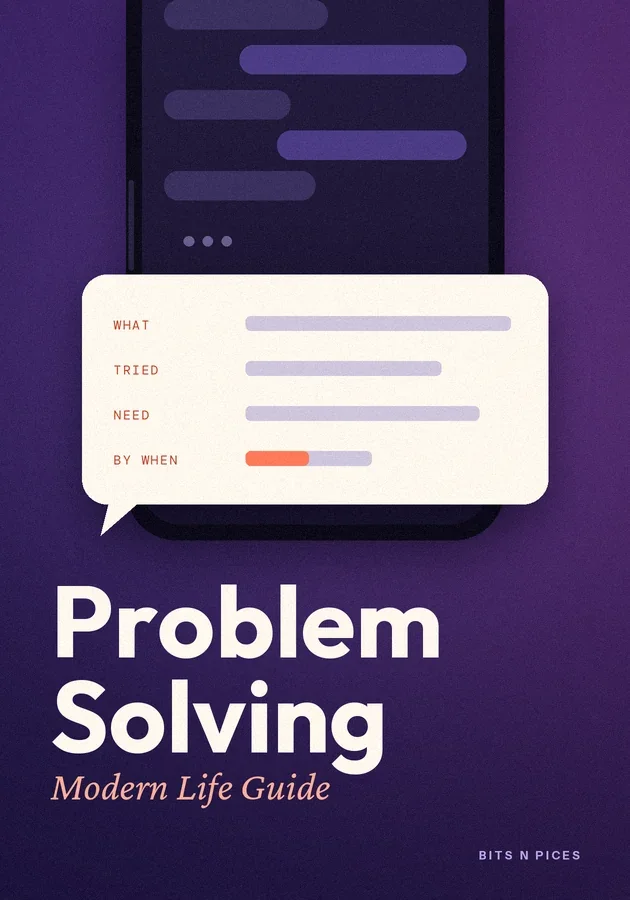
Problem Solving: Modern Life Guide
Principais ideias
- Before searching for a fix, write down exactly what happens, when it happens and what changed, so you solve the real problem.
- Trust the maker's own help pages first, try reversible fixes before permanent ones, and never give a password or code to anyone who contacts you first.
- Post remote problems as one message saying what is happening, what you tried, what you need and by when, and move to a call after three rounds.
- Set your own pause threshold before money pressure hits, and split any urgent problem into a small temporary fix and a calmer decision.
- Give every shared family problem one named owner and one date, and protect a notification-free problem hour for decisions that are hard to undo.
Dentro deste bit
- Old method, new conditions
The basic method of problem solving has not changed: name the problem, understand its causes, choose among options, try one and check the result. What has changed is the conditions around it.
- Searching for fixes without getting lost
Online help is a huge advantage if you search like an investigator rather than a shopper. Start by writing the symptom precisely: what happens, when, on which device or in which situation, and what changed recently.
- Solving problems with people you rarely see
Remote and hybrid work changed how problems travel. A problem that once took a walk to a colleague's desk now lives in a chat thread, and threads are good at collecting opinions but poor at reaching decisions.
- Money pressure and decisions under strain
Money worries change how people solve problems. When something is urgent and expensive, attention narrows to the fastest way out, and the fastest option is often the costliest over time.
- Family problems in the group chat
Family life now runs partly through group chats, and they bring a particular trap. When a problem is posted where everyone can see it, each person assumes someone else will act.
- Protecting attention for problems that matter
The last modern pressure is overload. Notifications, news and messages break attention into small pieces, and hard problems need unbroken time.
Aprende de seis maneiras
Visualizar, Mapa Mental, Praticar, Cenário, Desafio e Revisão foram criados para este livro.
Quiz e flashcards
Testa o que leste e guarda-o com repetição espaçada.
Bits AI
Responde sobre o livro, a secção e a pergunta do quiz em que estás.





