

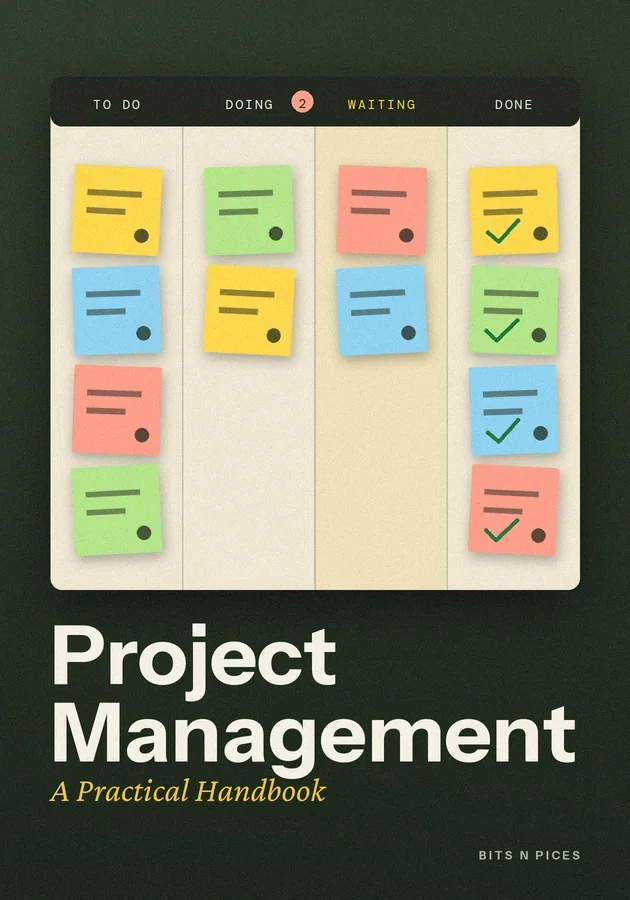
Project Management: A Practical Handbook
Principais ideias
- Start every project, at work or at home, with a one-page brief that names the outcome, the limits, what you will not do and who decides.
- Run a thirty-minute sticky-note session where everyone lists tasks silently first, then group the notes and put one owner's initials on each.
- Keep a four-column task board with a Waiting column and a limit of two tasks in progress per person, so blockages show up early.
- Before a child owns a task, agree together what good enough looks like, then resist redoing their work so the ownership stays real.
- Give every high-impact risk a fallback and a check date, and review the board, the dates and the risks for twenty minutes each week.
Dentro deste bit
- The one-page brief, field by field
Every project in this handbook starts with the same one-page brief, whether it is a system upgrade at work or turning the spare room into a study. It has seven fields: purpose, outcome and date, budget, limits, not doing, who decides, and who needs to know.
- Running a thirty-minute breakdown session
A plan made by one person misses things the rest of the household would spot in seconds. The breakdown session fixes that in half an hour.
- A task board the whole household can read
A task board turns the plan into something everyone can see without asking you. Draw four columns on a door, the fridge or a sheet of card: To do, Doing, Waiting and Done.
- Owners, helpers and deciders
Confusion about roles causes more friction than confusion about tasks. For each chunk on the board, name four things.
- The ten-minute risk list
A risk list is a short written answer to one question: what could go wrong, and what would we do? Take ten minutes, list five to ten risks, and mark each one high or low for how likely it is and how much it would hurt.
- The weekly review and the closing talk
Twenty minutes on the same day each week keeps a project alive. Clear the board: move finished notes to Done and question anything that has sat in Doing for a week.
Aprende de seis maneiras
Visualizar, Mapa Mental, Praticar, Cenário, Desafio e Revisão foram criados para este livro.
Quiz e flashcards
Testa o que leste e guarda-o com repetição espaçada.
Bits AI
Responde sobre o livro, a secção e a pergunta do quiz em que estás.





