

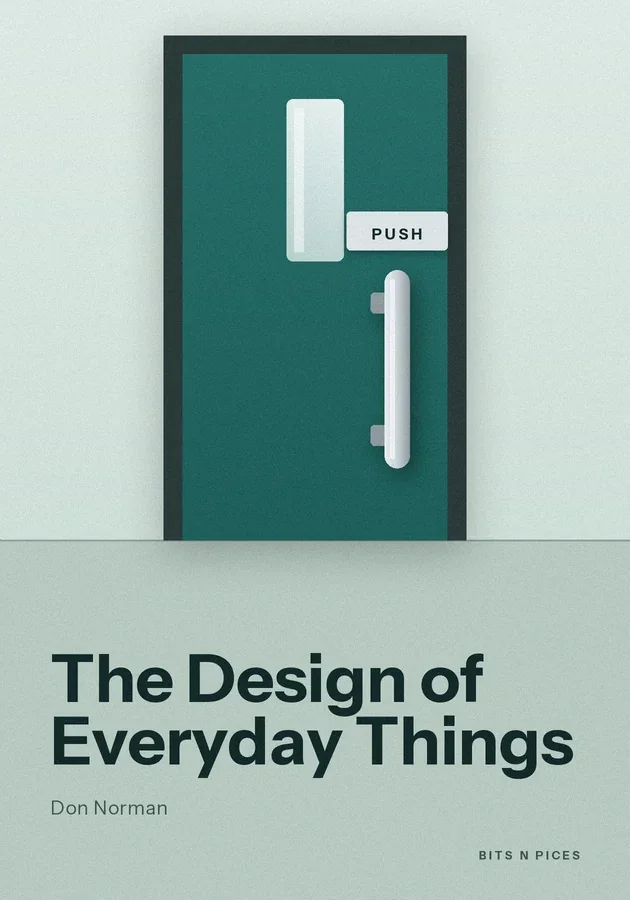
The Design of Everyday Things
Principais ideias
- When you struggle with a door or an app, blame the design, not yourself
- Good design shows what actions are possible and what will happen when you take them
- Every action needs quick, clear feedback so the user knows it worked
- People build mental models from what they see, so make the system's logic visible
- Assume errors will happen and design so they are easy to notice and reverse
Dentro deste bit
- Blame the door, not yourself
You walk up to a glass door with a handle and pull. It does not move.
- Affordances and signifiers
Norman's most famous idea is the affordance: the relationship between an object and what a person can do with it. A chair affords sitting; a flat plate on a door affords pushing; a handle affords pulling.
- Feedback and the gulfs of action
Norman describes 2 gaps that every user has to cross. The gulf of execution is the gap between what you want to do and working out how to do it with this object.
- Conceptual models in the user's head
People do not read manuals. They build a story about how a thing works from what they can see, and then act on that story.
- Design for error
People will make mistakes, so Norman argues that blaming them is lazy and that the real work is designing so errors are hard to make and easy to undo. He separates slips, where you intend the right thing but your hand does the wrong thing, from mistakes, where your plan itself is wrong because your model is wrong.
- Coloque em prática
This week, notice 3 everyday objects or screens that make you hesitate, and for each one name the missing signifier, feedback or mapping instead of blaming yourself. Take something you have built, a form, a slide, a small app, a process at work, and watch one person use it for the first time without helping them; every pause is a design note.
Aprende de seis maneiras
Visualizar, Mapa Mental, Praticar, Cenário, Desafio e Revisão foram criados para este livro.
Narrado
Ouve este bit, lido por Michael ou Bella.
Quiz e flashcards
Testa o que leste e guarda-o com repetição espaçada.
Bits AI
Responde sobre o livro, a secção e a pergunta do quiz em que estás.





