

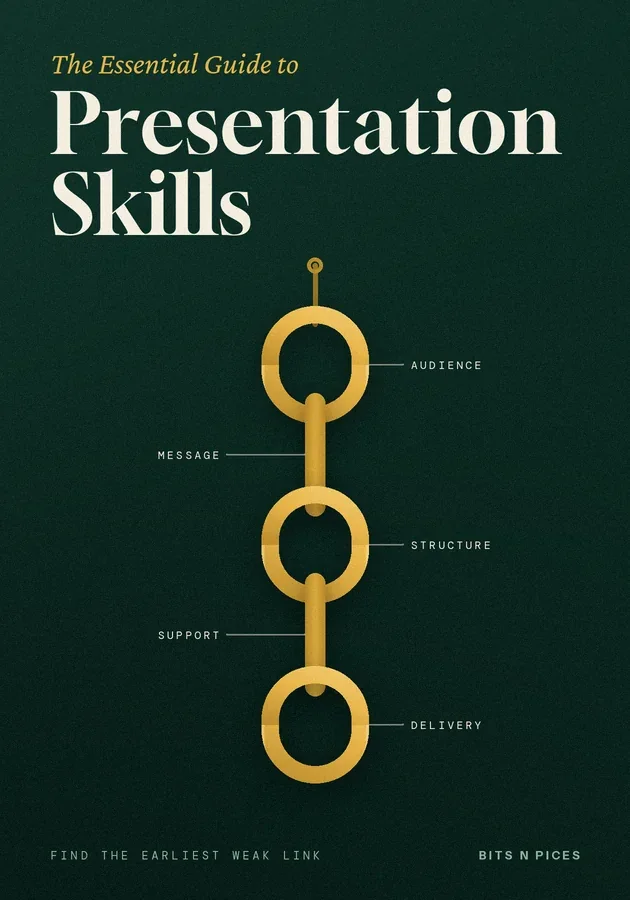
The Essential Guide to Presentation Skills
Principais ideias
- Every talk rests on five linked ideas, audience, message, structure, support and delivery, and the earliest weak link explains most problems further down.
- Before opening any slides, name the deciders, doers and doubters in the room, then write the one sentence you want them all to repeat.
- Give listeners a path: say where you are going, cover no more than three points, and close by repeating your message with a clear next step.
- Use a story to make a point memorable, a number to make it credible and a slide only when seeing beats hearing.
- Spend practice time on pace first, and ignore animated slides, word-for-word memorising and perfect hand positions until the early links are strong.
Dentro deste bit
- Five ideas that hold every talk together
A presentation is any time you speak to a group with a purpose, whether that is a ten-minute update at work, a proposal at a residents' meeting or a talk to a class. Nearly all the advice about presenting fits inside five ideas.
- Audience: deciders, doers and doubters
An audience is rarely one group. In most rooms sit three kinds of listener.
- Message and structure: the spine of the talk
Your key message is the one sentence you want listeners to repeat afterwards. It is a claim or a request, not a topic: not the new rota, but the new rota gives everyone one free weekend a month if we start in June.
- Support: stories, numbers and slides
Support is whatever makes your message believable and memorable, and each kind has a trade-off. A story, one person and what happened to them, is remembered long after the talk but can wander if it runs past a minute.
- Delivery: voice, eyes and the nerves you bring
Delivery has a small vocabulary. Pace is how fast you speak; most nervous speakers go too fast.
- Questions, priorities and what to ignore
Questions at the end are the audience telling you which link they doubt, so sort each one before you answer. Why are we doing this?
Aprende de seis maneiras
Visualizar, Mapa Mental, Praticar, Cenário, Desafio e Revisão foram criados para este livro.
Quiz e flashcards
Testa o que leste e guarda-o com repetição espaçada.
Bits AI
Responde sobre o livro, a secção e a pergunta do quiz em que estás.





