

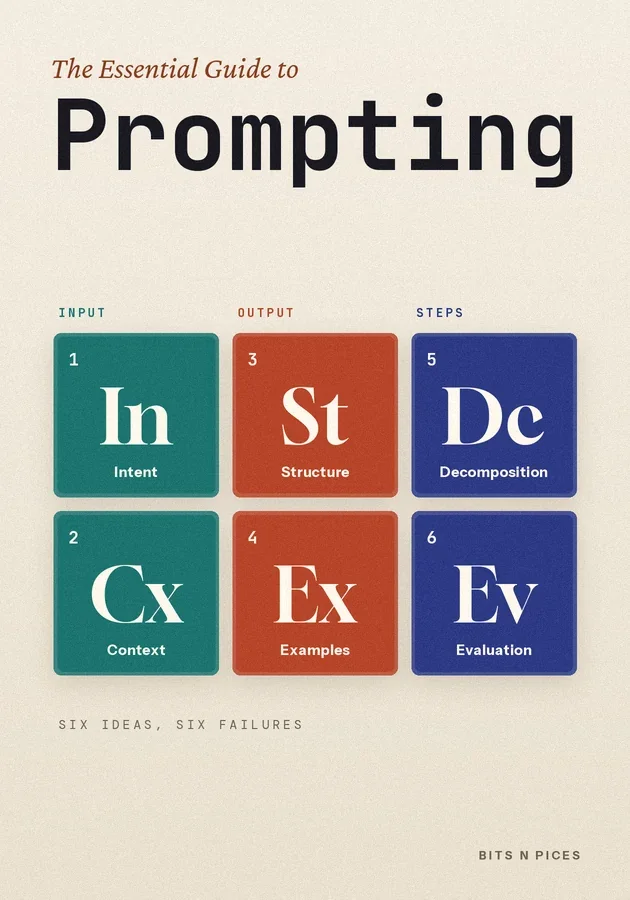
The Essential Guide to Prompting
Principais ideias
- Six ideas explain almost all of prompting: intent, context, structure, examples, decomposition and evaluation, and each one fixes a specific kind of failure.
- Context is a trade-off, not a virtue: too little makes the tool guess, too much buries the task, so give only what changes the answer.
- Examples are the strongest lever you have and also the stickiest, because the tool copies their flaws as faithfully as their strengths.
- Break any job with more than one judgement into steps, and let the tool critique its own draft against a rubric before you read it.
- Prioritise a clear task, a tested rubric and a few good examples; ignore magic phrases, elaborate personas and anything you cannot measure.
Dentro deste bit
- The map: six ideas that cover nearly everything
Prompting advice arrives as hundreds of tips, most of them true and none of them organised. Underneath them sit six ideas.
- Intent and context: the input side
Intent sounds obvious and is the idea most often skipped. 'Summarise this' is not an intent; 'give me enough to decide whether to attend this meeting' is.
- Structure and examples: the output side
Structure is the shape you ask for: a table with named columns, a numbered list of exactly five, a paragraph then a one-line recommendation, a JSON object with fixed keys. Naming the structure costs one sentence and removes most of the editing afterwards.
- Decomposition: one judgement per step
A prompt that asks the tool to research, decide, write and format in one breath asks for four judgements at once and gets each done at a quarter of its ability. Decomposition splits the job so that each step needs one judgement.
- Evaluation: how you actually get better
Without evaluation, prompting is superstition: you change a word, the answer improves, and you cannot tell whether the word or the dice did it. Evaluation starts with a rubric, three to five statements a good output must satisfy, written before you look at the reply.
- What to prioritise and what to ignore
With the map in hand, priorities are clear. Spend your effort on a named intent, on context that would change the answer, on one deliberately chosen example, and on a rubric you test against.
Aprende de seis maneiras
Visualizar, Mapa Mental, Praticar, Cenário, Desafio e Revisão foram criados para este livro.
Quiz e flashcards
Testa o que leste e guarda-o com repetição espaçada.
Bits AI
Responde sobre o livro, a secção e a pergunta do quiz em que estás.





