

核心要点
- Meet anyone new in three parts: your name, your link to the place or person, and one open question tied to that link.
- Write a swap list of your five most-used questions and rewrite each as a specific what or how question, dropping the why.
- Put the headline first when you need something: the point, one reason, a specific ask, and a check that confirms the next step.
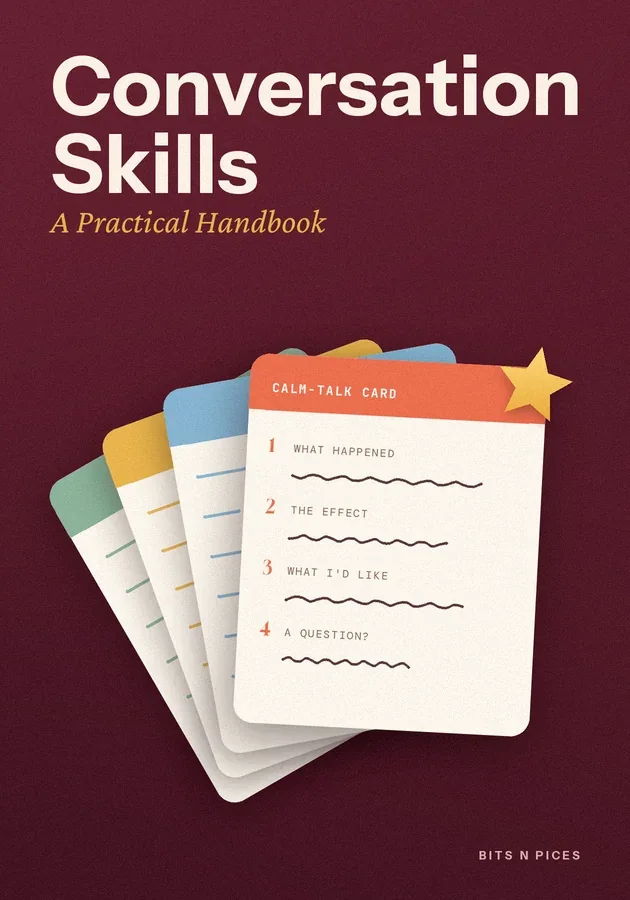
- Before a difficult talk, write four lines on a card, what happened, the effect, what you would like and a question, then choose a private moment.
- Rehearse real conversations as a family for ten minutes one evening a week, swapping roles, and give feedback as one star and one step.
本篇内容
- The name-link-question opener
Most people freeze when meeting someone new because they do not know what to say first. The name-link-question opener gives you the first ten seconds every time.
- The question swap list for better answers
Some questions are built to get one-word answers. How was school gets fine.
- Headline first: a template for asking clearly
Many requests fail because the point arrives last, after a long story the listener has stopped following. Headline first fixes this with a four-part template you can write on a card.
- Voice, pace and face: a delivery checklist
The same words can land as calm or as a telling-off depending on how they are said. Tone is the feeling carried by your voice, and listeners pick it up before they have processed your words.
- The calm-talk card for difficult conversations
A difficult conversation is any talk where feelings are strong, views differ and something matters. Four lines prepared on a card keep you steady.
- Family role-play and the star-and-step review
Skills grow with practice and honest feedback, and a family can supply both in ten minutes a week. On one set evening, every person names one real conversation coming up: asking a shopkeeper to exchange shoes, joining a game at the park, asking a manager for a shift swap.
六种学习方式
为本书专门编写了可视化、思维导图、练习、场景、挑战和复习模式。
测验与抽认卡
测试你的阅读成果,并通过间隔重复巩固记忆。
Bits AI
它可以根据你正在看的书籍、章节或测验题来回答。





