

核心要点
- Your rung depends on the setting, so replay how your last three conversations there ended and start climbing where it matters most this month.
- Answer plus one: give your answer, add one hook such as a detail, an opinion or a question back, and hand the turn over within twenty seconds.
- Ask two follow-ups on the thread with the most feeling before opening a new topic, and let the thread go when the answers get shorter.
- Share as well as ask, matching the other person's depth and linking your story to theirs in a sentence or two before handing back.
- Practise one move a week in low-stakes places, note how each conversation ended, and treat people seeking you out again as proof you have climbed.
本篇内容
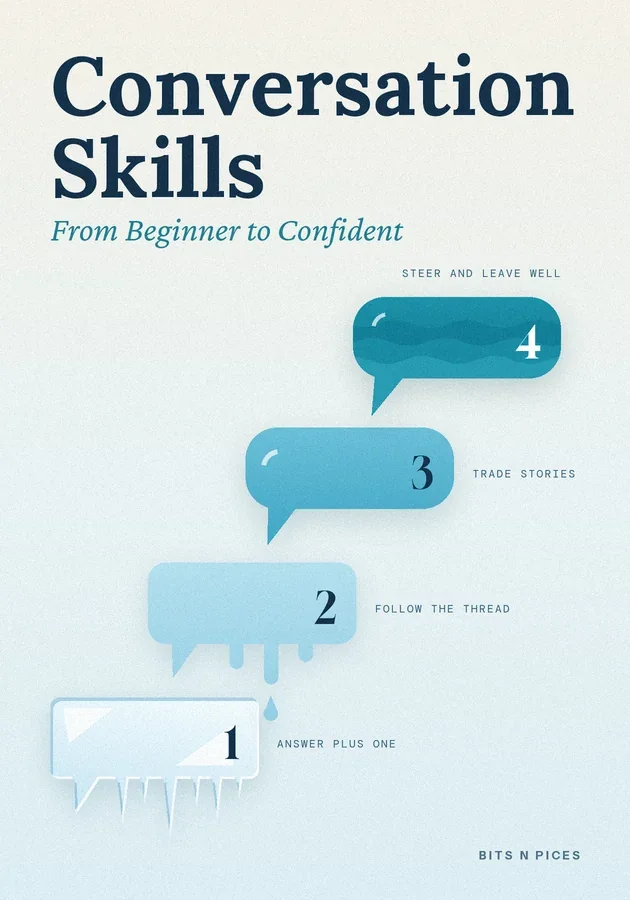
- Four rungs between freezing and flowing
Confidence in conversation is not a personality trait you either have or lack. It is a set of skills that stack, and most people climb them in the same order.
- Rung one: answers that give something back
Most people stuck on rung one are not rude or dull; they give closed answers. Did you have a good weekend?
- Rung two: following the thread
On rung two you stop asking new questions and start asking the next question. Most stalled conversations are a string of unrelated openers: what do you do, where do you live, how was the traffic.
- Rung three: trading stories, not running interviews
Questions alone eventually feel like an interview. Rung three adds the other half of the exchange: you share as well as ask.
- Rung four: steering, including and leaving well
On rung four you can shape a conversation without taking it over. Three moves mark the rung.
- Low-stakes reps and the evidence of progress
You climb by practising one move at a time where mistakes cost nothing. Low-stakes reps are everywhere: the vegetable seller, the colleague at the kettle, the person beside you in a long queue.
六种学习方式
为本书专门编写了可视化、思维导图、练习、场景、挑战和复习模式。
测验与抽认卡
测试你的阅读成果,并通过间隔重复巩固记忆。
Bits AI
它可以根据你正在看的书籍、章节或测验题来回答。





