核心要点
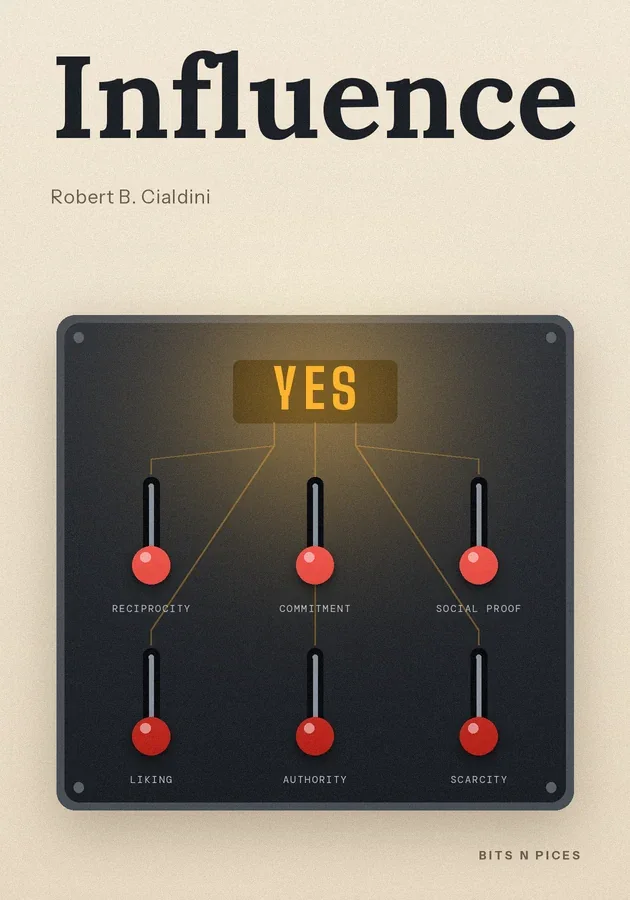
- We rely on mental shortcuts to say yes, and persuaders exploit those shortcuts
- A small unrequested favour creates a strong pull to give something back
- Once people commit publicly, they act to stay consistent with that commitment
- In uncertain moments we copy what similar people are doing around us
- Authority symbols and scarcity signals switch off careful thinking, so pause before acting
本篇内容
- Why we say yes on autopilot
A jeweller once doubled the price of some turquoise pieces by mistake, and they sold out because customers assumed expensive meant good. Robert Cialdini, a social psychologist, opens with stories like this to make a single point: most of the time we do not think our way to a decision, we react to a trigger.
- The pull of a free gift
The rule of reciprocity says that when someone gives us something, we feel a strong obligation to give back. It is one of the oldest social rules, because it let early humans share food and favours without keeping ledgers.
- Commitment and consistency lock us in
Once we take a stand, we feel pressure from inside and outside to behave in line with it. Consistency is admired, and it saves us from re-thinking things.
- Social proof and liking
When we are unsure what to do, we look at what other people are doing, especially people like us. That is social proof, and it explains laugh tracks, tip jars seeded with notes, and product pages boasting about bestsellers.
- Authority and scarcity
We defer to authority, often to its symbols rather than its substance. A title, a uniform, or an expensive car can be enough to switch off our judgment, which is why actors in doctors' coats sold medicine on television for years.
- Put it to work
This week, notice one moment when someone gives you something small before asking for something bigger, and decide consciously whether to reciprocate. When you want to build a habit, make a small public commitment to a friend so consistency works for you.
六种学习方式
为本书专门编写了可视化、思维导图、练习、场景、挑战和复习模式。
语音朗读
聆听此内容,由 Michael 或 Bella 朗读。
测验与抽认卡
测试你的阅读成果,并通过间隔重复巩固记忆。
Bits AI
它可以根据你正在看的书籍、章节或测验题来回答。