

核心要点
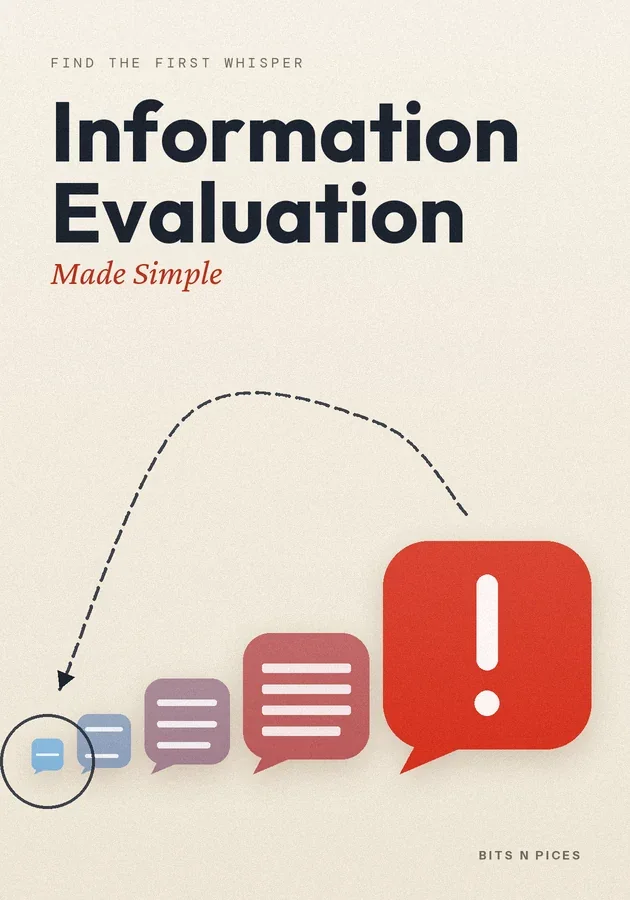
- Forwarded claims play the whisper game, losing context and gaining drama with every retelling, so find the first whisper in the line before you judge.
- A racing pulse is a smoke alarm, not proof of fire, and some messages are built to set it off, so pause before passing anything on.
- Three plain questions do most of the work: where did this start, who gains if I believe it, and what do people who would know say?
- Apps learn what keeps your child watching and bring more of it, so a claim that seems to be everywhere may only be everywhere on one screen.
- Corrections travel slower than rumours, so teach children the tricks before they meet them and lead any correction with the accurate version.
本篇内容
- Two pictures that explain most of it
If information evaluation feels like a subject with too many rules, hold on to two pictures instead. The first is the whisper game children play at parties.
- Four myths that fool sensible families
Four myths make intelligent people easier to fool. The first is that fake news looks fake.
- Three questions that do most of the work
You do not need a course. Three plain questions, asked in order, catch most of what matters.
- Three tricky cases that fool careful people
Once the basics are habits, three trickier cases remain. The first is a kernel of truth wrapped around a false conclusion.
- Feeds, repetition and tired brains
Some of what makes information hard to judge sits not in the message but in the system that delivers it. A video app behaves like a shop assistant who watches what you pick up and keeps bringing more of the same.
- Teach the trick before the trap
Two second-order facts shape everything a family can do. The first is that corrections travel more slowly than the claims they correct.
六种学习方式
为本书专门编写了可视化、思维导图、练习、场景、挑战和复习模式。
测验与抽认卡
测试你的阅读成果,并通过间隔重复巩固记忆。
Bits AI
它可以根据你正在看的书籍、章节或测验题来回答。





