

核心要点
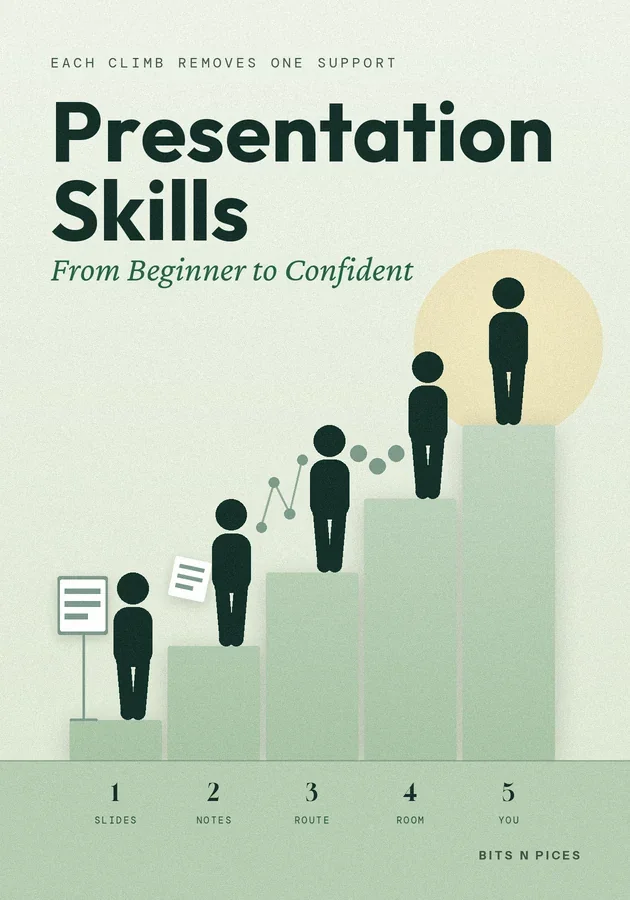
- Your presentation stage is defined by what you lean on, slides, notes, structure, audience or yourself, and each climb removes one outside support.
- Move from stage one to two by taking the words off your slides and into your notes, keeping slides for what people must see.
- At stage three, trade sentences for a route of key words, so your eyes stay on people and a slip costs nothing.
- At stage four, ask the room a real question, borrow their examples and treat puzzled faces as requests for another example.
- Climb by removing one support at a time and keeping a short log; confidence follows each climb rather than arriving before it.
本篇内容
- Five stages, named by what you lean on
Every presenter leans on something, and what you lean on tells you where you are on the ladder. At stage one you lean on the slides or a script: the screen carries the talk, so you face it and read.
- Stage one to two: moving the words off the slides
Stage one is where most people start, and it is not a failure; it is a talk held up by the slides. The climb to stage two has one move: take the words off the screen and put them in your notes.
- Stage three: trading sentences for a route
At stage two the talk lives in your notes, so your eyes keep dropping to them. Stage three moves it into your head, not as sentences but as a route.
- Stage four: letting the room shape the talk
At stage four you stop delivering a talk to people and start having it with them. Three habits mark the change.
- Stage five: one talk, any room, any length
At the top of the ladder you lean on your own understanding. You know the message so well that you can squeeze the talk to two minutes or stretch it to twenty, and change it for a different audience, without panic.
- How to practise so you actually climb
You do not climb by giving more talks the same way; you climb by removing one support at a time and practising until you can manage without it. Call it the strip-back cycle.
六种学习方式
为本书专门编写了可视化、思维导图、练习、场景、挑战和复习模式。
测验与抽认卡
测试你的阅读成果,并通过间隔重复巩固记忆。
Bits AI
它可以根据你正在看的书籍、章节或测验题来回答。





