

核心要点
- The fundamentals still hold: every project trades scope, time, cost and quality, and modern tools only change how fast those trade-offs surface.
- Pick one source of truth for tasks, decisions and files, and retire any app that has not earned its place within a month.
- Remote teams run on writing, so record every decision with its owner, reason and date and nobody depends on who attended which call.
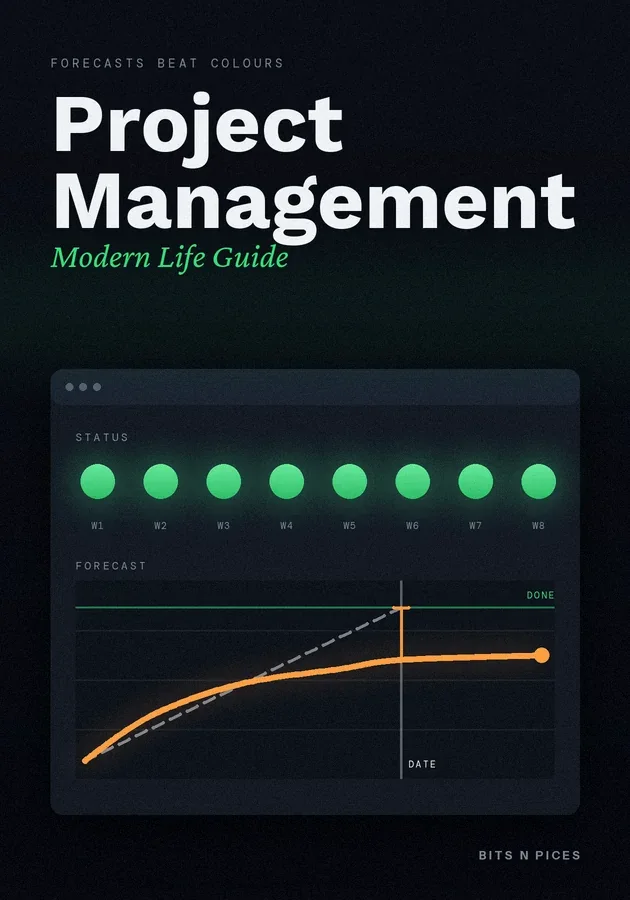
- Report status as a forecast with a reason rather than a colour, and distrust any dashboard that has stayed green for weeks.
- Run home projects like work ones, with a written scope, a contingency held back and a family agreement on who decides what.
本篇内容
- What changed and what still holds
The core of project management is older than any app. A project is temporary work that produces something new, and it always balances scope, time, cost and quality against the people available.
- When the app becomes the project
Most teams now juggle a task board, a chat tool, email, a shared drive, a video platform and a spreadsheet someone built in a hurry. Each tool solves a real problem, but together they create a second-order cost: the work of keeping them in step.
- Coordinating across screens and time zones
Distributed teams lose the hallway, the quick glance that tells you a colleague is stuck. What replaces it has to be deliberate.
- Green dashboards and other status illusions
Information overload does not only waste time; it hides risk. A project can show green on every report while quietly failing, the so-called watermelon project, green outside and red inside.
- Home projects under money pressure
Many of the projects that matter most never appear on a work plan: a flat renovation, a wedding, a move to a new city, a small shop opening. They carry real money, emotional stakes and stakeholders who share a dinner table, which makes them harder than most office work, not easier.
- Credentials, proof and your own judgement
Project management certificates are now easy to find, study for on a phone and add to a profile, which is both their strength and their limit. A recognised credential shows you know the shared vocabulary and can pass a structured exam on process.
六种学习方式
为本书专门编写了可视化、思维导图、练习、场景、挑战和复习模式。
测验与抽认卡
测试你的阅读成果,并通过间隔重复巩固记忆。
Bits AI
它可以根据你正在看的书籍、章节或测验题来回答。





