

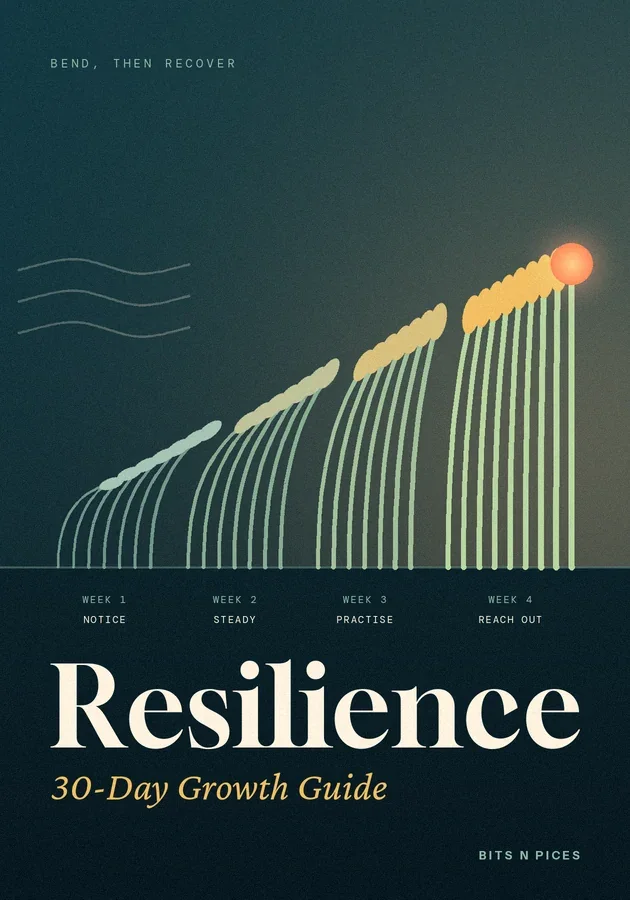
核心要点
- Resilience is the ability to bend under pressure and recover, and it grows through small daily practice rather than a sudden change of personality.
- Spend the first week only noticing: a two-minute evening check-in on body, thoughts and behaviour reveals your personal early warning signs.
- When stress rises, a slow breath with a longer exhale, naming the feeling and asking what else could be true will steady you within minutes.
- Treat each setback as practice material by writing what happened, what was in your control and one small next step, then doing that step.
- Measure progress by how quickly you recover rather than how rarely you struggle, and resume a slipped week at the missed day, not day one.
本篇内容
- What thirty days can and cannot change
Resilience is the ability to bend under pressure and come back to a workable shape. It is not being unbothered, and it is not a fixed trait you either have or lack.
- Week one: learning your early warning signs
The first week asks you to change nothing. You only notice.
- Week two: steadying your body and thoughts
Week two gives you three tools. Practise one each day, and by the weekend use all three together.
- Week three: using setbacks as practice material
By week three you have signals and tools. Now you use them on real difficulty.
- Week four: reaching out and letting others in
The last week turns outward, because resilience is rarely a solo effort. People who recover well from hard periods usually have a few relationships where they can say how things really are.
- Tracking progress and rescuing a slipped week
Measure the right thing. Resilience does not mean fewer bad days; it means shorter ones.
六种学习方式
为本书专门编写了可视化、思维导图、练习、场景、挑战和复习模式。
测验与抽认卡
测试你的阅读成果,并通过间隔重复巩固记忆。
Bits AI
它可以根据你正在看的书籍、章节或测验题来回答。





