

核心要点
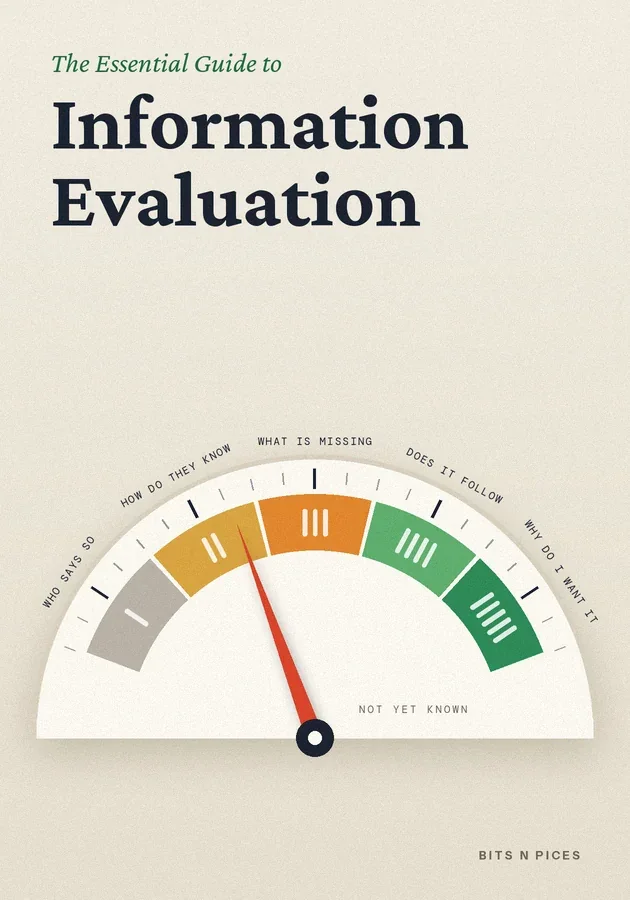
- Every claim can be weighed with five questions: who says so, how do they know, what is missing, does the conclusion follow, and why do I want it?
- Trust a source for what it knows rather than who it is: expertise must match the claim, and an incentive means the claim needs stronger support.
- Evidence comes in grades, from a single story to many independent studies agreeing, and surprising or costly claims need support from the stronger end.
- Many misleading claims are built from true facts, so check the time window, the total, the comparison and the full quote before you judge.
- Spend checking effort where the stakes are high, discount surface polish, and treat 'not yet known' as a respectable answer rather than a failure.
本篇内容
- The map: five questions and a dial
Information evaluation can feel like a heap of unrelated tips. It becomes manageable once you see that nearly every tip answers one of five questions.
- Source: expertise, incentives and accountability
Judging a source means asking three separate things. Expertise: does this person or organisation have specific knowledge of this particular question?
- Evidence: grades, not yes or no
Evidence is rarely simply present or absent; it comes in grades. At the weak end sits a single story: my cousin tried it and it worked.
- Context: when true facts mislead
Many misleading claims contain no false facts at all. They mislead through what is left out, and five patterns cover most of them.
- Reasoning, and the person doing it
Even true, well-sourced facts can be joined by faulty reasoning. The most common leap is from correlation to cause: towns with more libraries have more graduates, but both may simply follow income.
- What to prioritise and what to ignore
Nobody can check everything, so the essential skill is allocation. Prioritise claims that will change a decision, move money, affect health or safety, or that you are about to pass on.
六种学习方式
为本书专门编写了可视化、思维导图、练习、场景、挑战和复习模式。
测验与抽认卡
测试你的阅读成果,并通过间隔重复巩固记忆。
Bits AI
它可以根据你正在看的书籍、章节或测验题来回答。





