

核心要点
- Behaviour happens when motivation, ability and a prompt come together at once
- Make the habit so small that you can do it even on your worst day
- Anchor a new habit right after something you already do every day
- Celebrate immediately, because emotion is what wires a habit into place
- Design your environment instead of relying on willpower or motivation
本篇内容
- Change is easier when it is tiny
BJ Fogg, a Stanford behaviour scientist, once decided to do 2 push-ups every time he went to the bathroom. It sounds silly, but within months he was doing dozens a day without effort.
- The behaviour equation
Fogg's central model says a behaviour happens when 3 things line up at the same moment: motivation, ability and a prompt. He writes it as B equals MAP.
- Shrink it until it is easy
Fogg suggests two ways to make any behaviour tiny. Either take a starter step, like putting on your running shoes rather than running, or scale down the whole thing, like flossing 1 tooth instead of all of them.
- Anchor it to something you already do
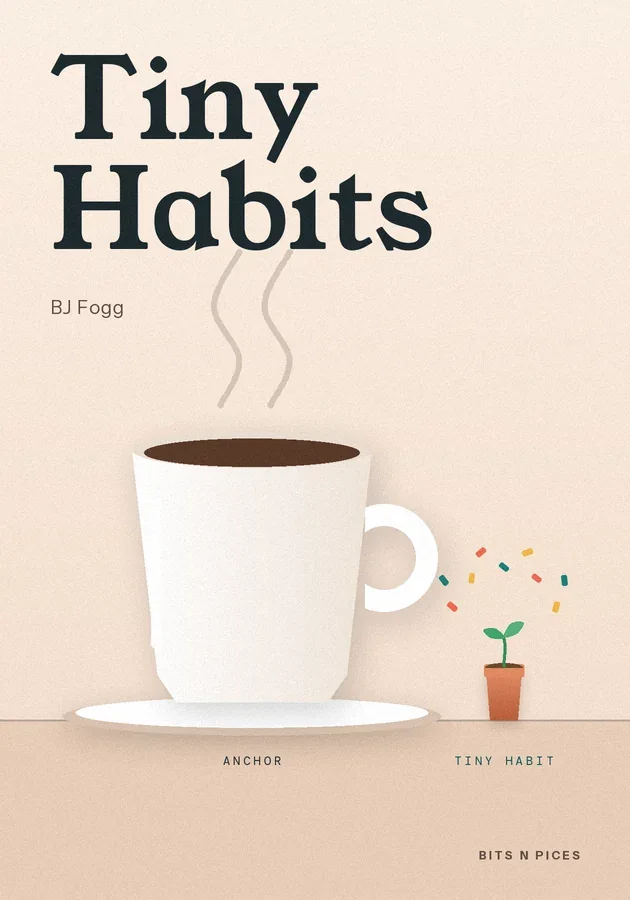
A new habit needs a reliable prompt, and Fogg says the best prompt is a behaviour already in your life. He calls this an anchor.
- Celebrate to wire it in
This is the part most habit advice misses. Fogg argues that habits form through emotion, not repetition alone.
- Put it to work
This week, choose one habit you want and shrink it until it takes under 30 seconds, like 1 push-up or writing 1 sentence. Find an anchor by listing 5 things you already do every day and picking the one that happens in the right place and at the right time.
六种学习方式
为本书专门编写了可视化、思维导图、练习、场景、挑战和复习模式。
语音朗读
聆听此内容,由 Michael 或 Bella 朗读。
测验与抽认卡
测试你的阅读成果,并通过间隔重复巩固记忆。
Bits AI
它可以根据你正在看的书籍、章节或测验题来回答。





