Key takeaways
- Science is a way of thinking that pairs wonder with ruthless skepticism
- Compressing cosmic time into one calendar year shows how brief human history is
- Every atom in your body was forged inside a star that died long ago
- Human progress has been fragile, lost for centuries when curiosity was suppressed
- Seeing Earth as one small world argues for care, cooperation, and restraint
Inside this bit
- A ship of the imagination
Carl Sagan begins by inviting you aboard an imaginary vessel that can travel anywhere in space and time, from the rings of Saturn to the library of ancient Alexandria. The book, written alongside a television series, is a grand tour of everything we know about the universe and how we came to know it.
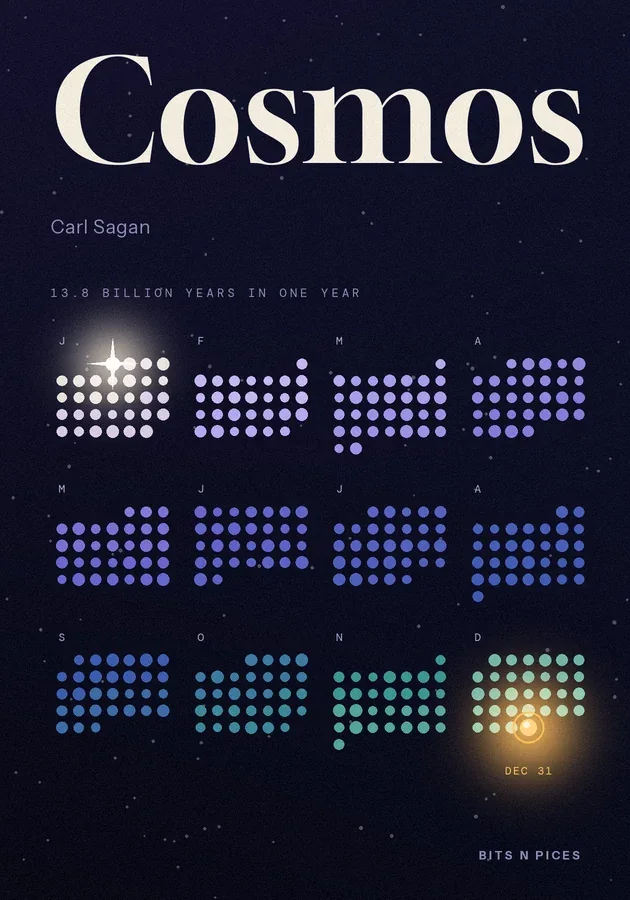
- The cosmic calendar
To make deep time feel real, Sagan squeezes the entire history of the universe, roughly 14 billion years, into a single calendar year. The Big Bang is midnight on 1 January.
- Made of star stuff
Where did the calcium in your teeth and the iron in your blood come from? Sagan explains that the early universe held almost nothing but hydrogen and helium.
- Alexandria and the price of ignorance
Sagan also tells a human history, and its lesson is sobering. In ancient Alexandria, scholars measured the size of the Earth with sticks and shadows, mapped the stars, and built the greatest library of the ancient world.
- Who speaks for Earth
The final chapters turn from the sky back to us. Sagan, writing in the shadow of the Cold War, asks what a visitor from another world would make of a species that has just learned to send probes past Jupiter and also built enough weapons to destroy itself.
- Put it to work
This week, step outside after dark, find one star or planet, and remind yourself that its light left long before you were born; that small act of attention is where science starts. Take one belief you hold firmly and ask what evidence would change your mind, then go looking for it, the way Kepler did.
Learn it six ways
Visualize, Mind Map, Practice, Scenario, Challenge and Review are written for this book.
Narrated
Listen to this bit, read by Michael or Bella.
Quiz and flashcards
Test what you read and keep it with spaced repetition.
Bits AI
It answers about the book, the section, the quiz question you are on.