

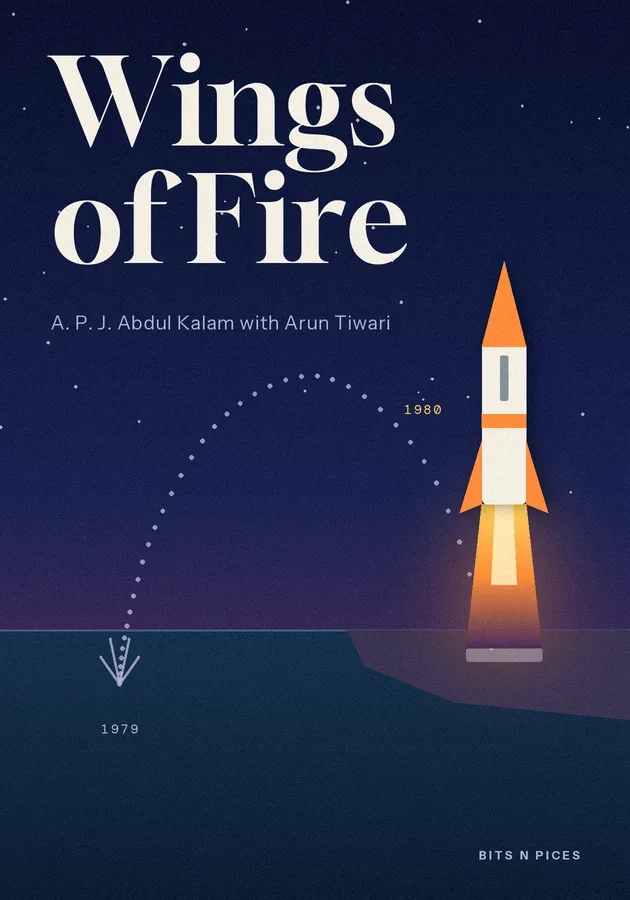
Wings of Fire
Key takeaways
- Ordinary beginnings do not limit you; curiosity, mentors and hard work do the lifting
- A closed door is often a redirection, not a verdict on your worth
- Big projects succeed when leaders take blame publicly and give credit generously
- Failure is information; the SLV-3 failed in 1979 and flew in 1980
- Build institutions and people, not just machines, if you want lasting impact
Inside this bit
- From Rameswaram to rockets
A boy from a small island town sells newspapers at dawn to help his family, and decades later he stands beside the rocket that puts India's first satellite into orbit. That arc is the heart of Wings of Fire.
- The people who shaped him
Kalam's father was a boat owner and a devout Muslim who quietly discussed scripture with the temple priest and the church father. His mother fed more mouths than the family could really afford.
- Doors that closed
After studying aeronautical engineering in Madras, Kalam wanted to fly. He travelled to Dehradun for the air force selection and finished just outside the number of places available.
- Leading the SLV-3 through failure
Kalam was made project director of India's first satellite launch vehicle, the SLV-3, coordinating hundreds of engineers across many centres. He describes the pressure of a first launch attempt in 1979 that failed minutes after liftoff.
- Missiles, teams and self-reliance
In the 1980s Kalam moved to defence research and led the programme that produced missiles such as Prithvi and Agni. Foreign suppliers refused key technology, so his teams built it at home, which he saw as a gift rather than a setback.
- Put it to work
This week, write down the names of 3 people who believed in you before you had proof, and send one of them a message of thanks. Identify one young person you could mentor, even informally, and offer 30 minutes of your time.
Learn it six ways
Visualize, Mind Map, Practice, Scenario, Challenge and Review are written for this book.
Narrated
Listen to this bit, read by Michael or Bella.
Quiz and flashcards
Test what you read and keep it with spaced repetition.
Bits AI
It answers about the book, the section, the quiz question you are on.





