

핵심 요약
- Spend the first week measuring rather than straining: a chair-stand test, a push-up test and a timed walking route give you a baseline worth beating.
- Build strength with double progression: stay at one difficulty until every set reaches the top of your rep range cleanly, then make the exercise harder.
- Keep most cardio easy enough to talk through and limit hard sessions to one or two a week, because stacked hard days drain recovery and stall progress.
- Retest on day twenty-eight under the same conditions as day one, then choose next month's single focus from whichever result moved least.
- When a week slips, repeat it rather than skipping ahead, never cram missed sessions into fewer days, and restart a week earlier after illness.
이 비트의 내용
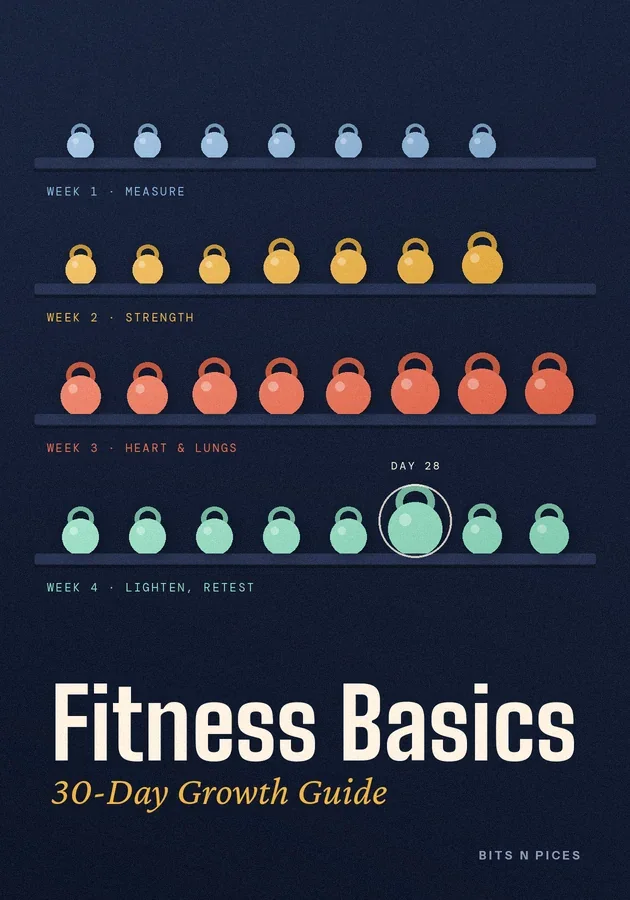
- How the four weeks fit together
This programme assumes you already move a little and know what a squat or a push-up is. Its job is to turn scattered effort into a month with a shape.
- Week one: measure before you push
Week one is for measuring and settling a rhythm, not for heroics. Pick three tests and record them carefully.
- Week two: strength with a progression rule
Week two brings three short full-body strength sessions, spaced so that no muscle group works hard two days running. Each session covers a squat, a hinge, a push, a pull and a carry or plank.
- Week three: training heart and lungs wisely
Week three adds conditioning, meaning work that trains the heart and lungs. Use three effort levels from the talk test: easy means you can speak in full sentences, moderate means short phrases, and hard means only a few words at a time.
- Week four: lighten, retest and plan
Fatigue hides fitness, so the first half of week four is lighter: the same sessions with fewer sets and no hard intervals. On day twenty-eight, repeat the week-one tests under identical conditions and lay the two sets of numbers side by side.
- When a week slips, and when to stop
Almost every thirty-day plan meets a lost week, so decide the rules now. If you miss a day or two, carry on from where you are.
여섯 가지 방법으로 배우기
이 책을 위해 시각화, 마인드맵, 연습, 시나리오, 챌린지, 복습 기능이 준비되어 있어요.
퀴즈와 플래시카드
읽은 내용을 테스트하고 간격 반복으로 확실히 기억하세요.
Bits AI
보고 있는 책, 섹션, 퀴즈 질문에 대해 답변해 줍니다.





