

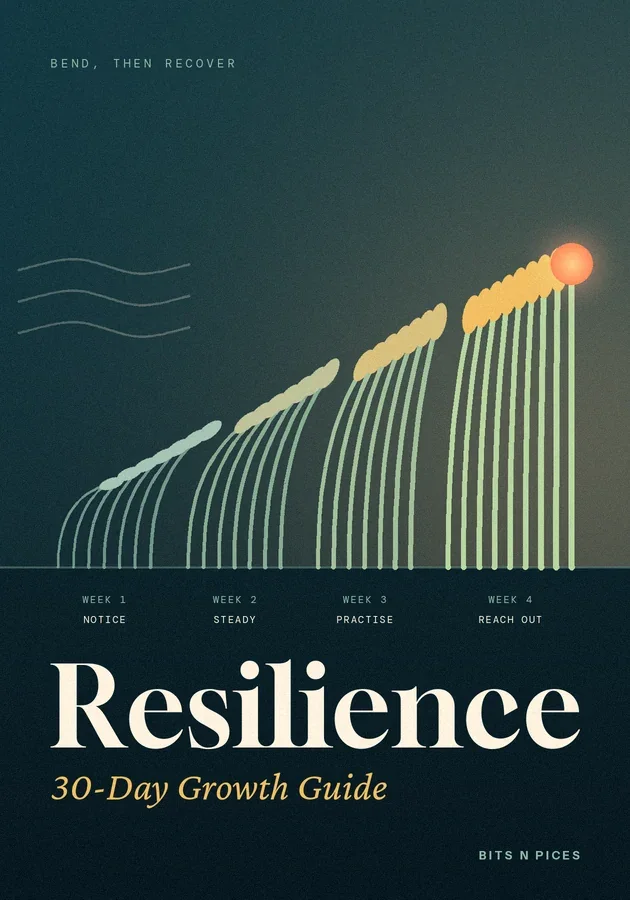
핵심 요약
- Resilience is the ability to bend under pressure and recover, and it grows through small daily practice rather than a sudden change of personality.
- Spend the first week only noticing: a two-minute evening check-in on body, thoughts and behaviour reveals your personal early warning signs.
- When stress rises, a slow breath with a longer exhale, naming the feeling and asking what else could be true will steady you within minutes.
- Treat each setback as practice material by writing what happened, what was in your control and one small next step, then doing that step.
- Measure progress by how quickly you recover rather than how rarely you struggle, and resume a slipped week at the missed day, not day one.
이 비트의 내용
- What thirty days can and cannot change
Resilience is the ability to bend under pressure and come back to a workable shape. It is not being unbothered, and it is not a fixed trait you either have or lack.
- Week one: learning your early warning signs
The first week asks you to change nothing. You only notice.
- Week two: steadying your body and thoughts
Week two gives you three tools. Practise one each day, and by the weekend use all three together.
- Week three: using setbacks as practice material
By week three you have signals and tools. Now you use them on real difficulty.
- Week four: reaching out and letting others in
The last week turns outward, because resilience is rarely a solo effort. People who recover well from hard periods usually have a few relationships where they can say how things really are.
- Tracking progress and rescuing a slipped week
Measure the right thing. Resilience does not mean fewer bad days; it means shorter ones.
여섯 가지 방법으로 배우기
이 책을 위해 시각화, 마인드맵, 연습, 시나리오, 챌린지, 복습 기능이 준비되어 있어요.
퀴즈와 플래시카드
읽은 내용을 테스트하고 간격 반복으로 확실히 기억하세요.
Bits AI
보고 있는 책, 섹션, 퀴즈 질문에 대해 답변해 줍니다.





