핵심 요약
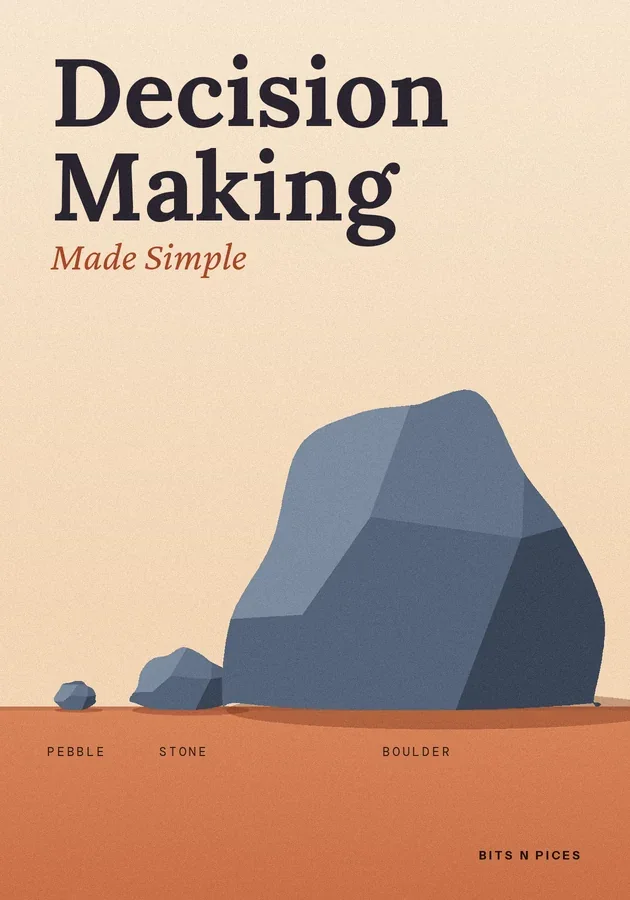
- Sort each choice as a pebble, a stone or a boulder, and save your slow, careful thinking for the few boulders that are hard to undo.
- When a choice comes with too many options, pick one filter, such as free or close to home, and cut the list to three before choosing.
- When you are stuck between two options, look for a third, then ask one question: what matters most here?
- Most everyday choices have several good-enough answers, so stop searching once an option clearly does the job instead of hunting for the perfect one.
- Teach children the three sizes and pause stories to ask what a character could choose, so they practise deciding where mistakes cost nothing.
이 비트의 내용
- Why deciding feels so hard at home
Parents are often told they make too many decisions. Just as often, the real trouble is too many options inside each one.
- Four myths that make deciding harder
Myth one: there is one right answer, and your job is to find it. Most everyday choices have several good-enough answers, and chasing the perfect one mostly produces delay.
- Pebble, stone or boulder: the one sort
If you keep one idea from this book, keep this one. Before deciding anything, ask how heavy it is.
- The simple method: three options, one question
When you feel stuck, you are usually stuck between two options, each with a drawback. The first move is to find a third.
- Giving children the three sizes
Children have the same sorting problem as adults, only louder. A seven-year-old can sob for twenty minutes over the colour of a pencil case, then agree in two seconds to a friend's dare to climb the school wall.
- A family habit: pause the story
Children practise deciding most easily on someone else's choices, because nothing is at stake for them. Stories give you endless material.
여섯 가지 방법으로 배우기
이 책을 위해 시각화, 마인드맵, 연습, 시나리오, 챌린지, 복습 기능이 준비되어 있어요.
퀴즈와 플래시카드
읽은 내용을 테스트하고 간격 반복으로 확실히 기억하세요.
Bits AI
보고 있는 책, 섹션, 퀴즈 질문에 대해 답변해 줍니다.